

In 2026, Jaupavi renewed its ITGA ESG Sustainability Diamond Seal, following an audit process that assessed actions, records, and evidence related to the environmental, social, and governance practices developed by our company.
The assessment covered the period from June 12, 2025, to June 12, 2026, and was conducted based on recognized sustainability parameters. The process and materiality analysis followed the guidelines and indicators of the Global Reporting Initiative (GRI 2021), with ESG goals connected to the 17 United Nations Sustainable Development Goals (SDGs) and ABNT PR 2030.
64 Concrete Sustainability Actions Validated
One of the main results of the audit was the validation of 64 concrete sustainability actions related to the 17 SDGs. This result contributed to Jaupavi maintaining the Diamond level of the certification.
These actions are present across different areas of our operations and include initiatives related to waste management, efficient use of water and energy, employee health and safety, training, inclusion, gender equality, social initiatives, compliance, and governance mechanisms.
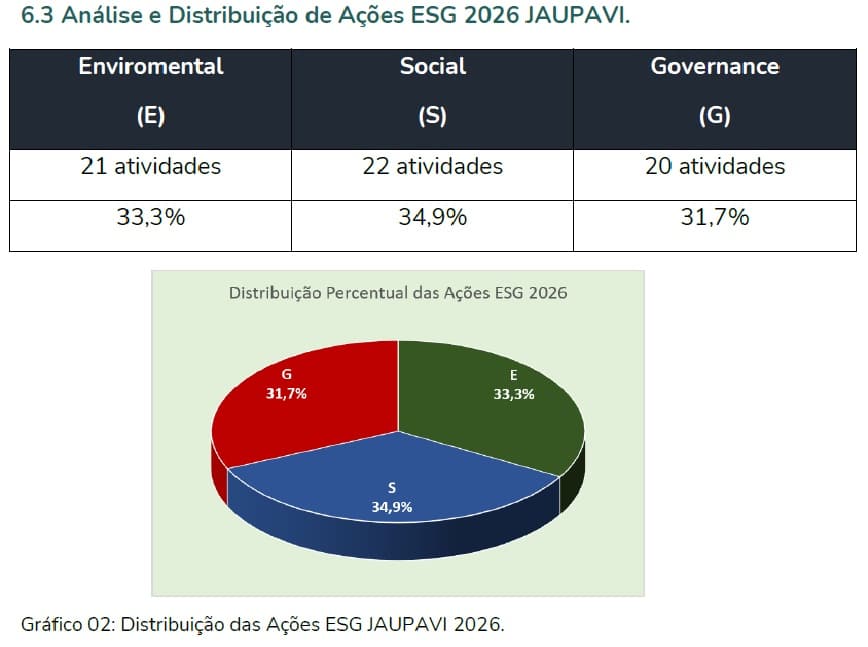
The report also demonstrates that ESG practices are distributed in a balanced manner across the three pillars. A total of 21 environmental activities, corresponding to 33.3%; 22 social activities, representing 34.9%; and 20 governance activities, equivalent to 31.7%, were recorded.
This distribution demonstrates an integrated approach in which sustainability encompasses environmental matters, people engagement, labor relations, society, and the way we conduct our management practices.
Audited and Verified Practices
The technical opinion concluded that the practices assessed demonstrate substantial adherence to ESG criteria, supported by evidence considered consistent, traceable, and incorporated into the company’s processes in a way that meets the criteria of ABNT PR 2030 and the GRI indicators used as a reference.
The renewal of the Diamond Seal therefore recognizes the advanced level of ESG maturity achieved by Jaupavi and encourages us to continue improving our practices, indicators, and processes in pursuit of increasingly responsible, transparent, and sustainable operations.